
published on Stories on Zalando
For decades, generations have found community and escapism through music, festivals and dressing up. Find out how.
The year is 2009, and Lady Gaga sings the lines “Just dance, gonna be okay” at Glastonbury festival to a dancing and singing crowd, who, at that moment, might believe that it’s indeed going to be okay. Gaga’s song was one of many pop dance anthems that emerged from ‘Recession Pop’, a phenomenon that occurred during the Great Recession of 2007-2009. Back then, songs with lyrics like “Keep on dancin’ ’till the world ends” by Britney Spears rose to popularity, implying that even during the worst times, there was a place and time to be carefree. Or, as Aurora Anderson wrote in an exploration of recession pop for Muse Magazine, “No matter how bad it gets, we will always have each other — that was the message being echoed on the radio every day.”
While recession pop kept us dancing and forgetting our problems during the late ’00s, it wasn’t the only music phenomenon offering a distraction from reality. To this day, one of the most prominent forms of escapism are festivals. According to music psychology researchers, escapism is one of the three primary motivators for people to attend the weekend-long events, as Noah Little wrote in a piece for EDM.com called ‘Why we rave? The human psychology behind attending a music festival’. “These types of environments are supplying individuals with a chance to escape from it all; a place where people feel free to express who they are, what they love, and without the judgmental eyes of society,” Little explained.
But festivals go beyond the opportunity to create an alternative world for the weekend. They nurture our desire for third places and community. Science backs this up, with music psychology researchers identifying opportunities for socialisation as a second common motivator for festival-goers. According to Little, the events give “a sense of camaraderie.” Pavel Davison, a frequent festival-goer who attends festivals about five times a year, agrees. “Community is what makes festivals special. It takes it from you being in a silo with headphones on to being in a tent with thousands of like-minded individuals with a common sense of enjoyment and desire to make the most of every day,” he tells us.
Surrounding oneself with like-minded people also played an essential role for the Woodstock attendees, who sought community in times of crisis and later found it in a crowd of more than 400,000. “The scale of Woodstock showed people who had considered themselves ‘freaks’ that they weren’t as small a minority as they had thought,” John Pareles wrote in the New York Times.
Their similarities ranged from their political views to their desire to escape reality, which even affected their way of dressing. To distance themselves from the realities of corporate life and its dress code, they embraced denim and “celebrated the handmade”, like crocheted vests and tie-dyed garments, Vanessa Friedman wrote in a piece for the New York Times titled ‘Woodstock Was the Birthplace of Festival Fashion’. The fashion at Woodstock was “originally based on rejection,” and was “anti-all those garments that had become synonymous with the working uniforms of avenues from Madison to Massachusetts,” she explained.
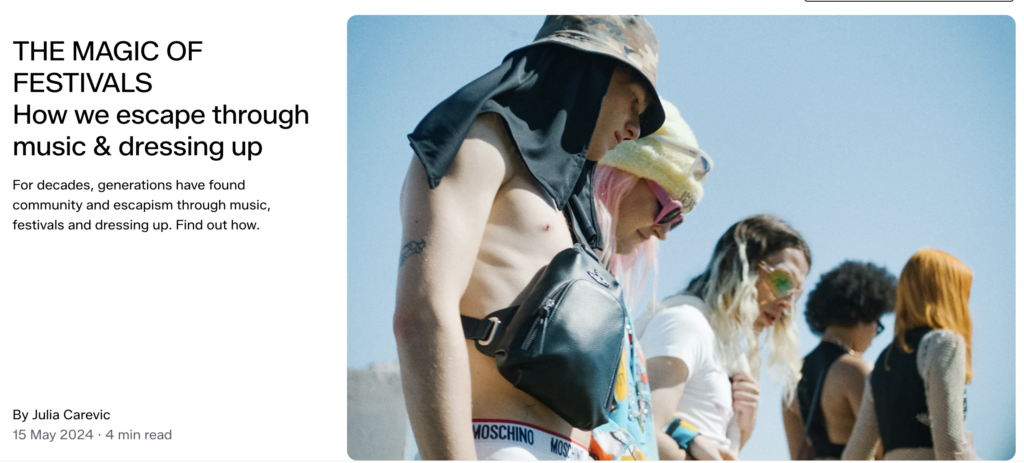
To this day, dressing the opposite of what’s often accepted in the corporate world plays a vital role in the festival experience. “[Putting an outfit together] is a very important element, given there’s a universally accepted stance that festival outfits have next to no boundaries. It’s your opportunity to step out of your comfort zone,” Davison explains. Whether it’s cowboy hats and sparkly tops or denim vests covered in patches, every major festival — from Coachella to Tomorrowland to Glastonbury and Wacken — has its style DNA, much like Woodstock, silently agreed upon by the crowd. And then, there’s the act of getting ready to see your favourite artist on stage, which often is a celebration and brings people closer together. Davison describes getting ready with his fiancée as the fun part of the day. “It’s where the vibes for the day start. Crank up the music on your Bluetooth speaker and set the tone for the day.”
From dancing and singing with a crowd full of strangers to meeting like-minded people to planning an outfit and getting ready with friends, moments like these allow us to forget our problems for a while. And, looking back, it is clear that music has given hope to generations for decades, and it continues to do so. Modern festivals may not be able to capture the feeling of Woodstock. Still, they offer some of the most important things for young people, if not for anyone of any age: a place where you can be yourself, make new friends, and escape reality, at least for a weekend.